Clear Lens Vision
Light focuses cleanly on the retina, so colours, contrast and night driving remain crisp.
Elderly patients and families guided through cataract, IOL choice and recovery
No injections. No stitches. No bandages. See clearly by tomorrow — with the region's most advanced cataract platform.
Patients often understand cataract best when they can see the problem: the natural lens becomes cloudy, light scatters, and vision becomes dull, hazy and glare-prone. Surgery replaces that cloudy lens with a clear intraocular lens.
Light focuses cleanly on the retina, so colours, contrast and night driving remain crisp.
Clouding creates glare, haloes, dull colours, frequent spectacle changes and difficulty reading or driving at night.
AI-guided measurements, micro-incision phaco and premium IOL planning are used to deliver no injection, no stitch, no bandage cataract surgery.
Cataract patients often describe the world as smoky, yellow and glare-filled. After the cloudy natural lens is replaced with a clear IOL, colours and contrast return.
Blur, glare, faded colours and haloes around lights make reading, faces and night driving difficult.
The cloudy lens is replaced with a transparent intraocular lens, restoring clarity and brightness.
A cataract is the gradual clouding of the eye's natural crystalline lens — the transparent structure that sits behind the pupil and focuses light onto the retina. As the proteins within the lens break down with age, they clump together and cause the lens to become progressively opaque, scattering and blocking incoming light.
The result is a steady deterioration of vision: colours appear faded, glare from lights intensifies, night driving becomes dangerous, and eventually reading and recognising faces becomes difficult. Cataracts are entirely painless and progressive — most patients don't notice the change until significant clouding has occurred.
The only treatment is surgical removal and replacement with a clear artificial intraocular lens (IOL). There are no eye drops, no medications, and no laser treatments that can reverse or slow cataracts once they begin. Surgery is 100% curative — and with modern robotic AI technology, it is also remarkably safe, fast, and comfortable.
Every cataract surgery at BMH follows a precision four-stage AI-guided protocol — from pre-surgical planning through to IOL placement — delivering sub-1mm accuracy unachievable with conventional techniques.
TOMEY Optical Biometer maps your eye's exact axial length, anterior chamber depth, corneal curvature, and lens position to compute your personalised IOL power with sub-micron precision.
Our AMO Signature platform with Ellips FX technology delivers transversal ultrasound — cutting the cataract lens with 40% less energy than conventional phaco, dramatically reducing heat and inflammation.
The cataract is emulsified through a self-sealing 2.2mm micro-incision. No sutures required — the incision is smaller than the tip of a ballpoint pen and self-seals through natural hydration.
Your chosen premium IOL is folded and injected through the same 2.2mm incision, then precisely centred in the capsular bag. AI-calculated power ensures the most accurate refraction outcome possible.
Result: Sub-1mm IOL placement accuracy · Self-sealing 2.2mm incision · Zero stitches · Zero injections
The same platform used in leading tertiary eye centres across the UK, US, and Europe — now available in Chandigarh.
Five reasons our cataract surgery is transforming what patients in Chandigarh expect from eye care.
Anaesthesia is administered as numbing eye drops only. No needle near or around the eye — ever. Patients are awake, comfortable, and pain-free throughout the entire procedure.
Topical Drops OnlyThe 2.2mm micro-incision is smaller than the cornea's natural self-sealing capacity. It closes securely through hydration alone — no sutures, no removal appointments.
2.2mm Self-sealingBecause there is no large incision, no injection site, and no wound to protect, patients leave the theatre with the eye open and uncovered. A protective shield is used overnight only.
Patch-FreeMost patients resume light daily activities — reading, walking, watching TV — within 24 hours of surgery. Driving is typically permitted after 1 week once vision is confirmed at review.
Next-Day ActivityCataract surgery costs are explained clearly before treatment. Private insurance documentation support can be provided where applicable, depending on policy terms.
Transparent estimateYour intraocular lens is the new permanent lens that replaces your cataract. At BMH, we offer four categories — each addressing a different visual need and lifestyle.
The most commonly used IOL worldwide. Provides excellent clarity at one focal distance — usually set for distance (driving, TV). Reading glasses will still be needed for near work.
A toric IOL corrects both the cataract and existing corneal astigmatism simultaneously in a single surgery — often achieving better unaided vision than the patient had before their cataract even developed.
Advanced diffractive optics provide clear vision at multiple distances simultaneously. Most patients achieve complete spectacle independence for all daily activities — reading, screens, and distance.
Extended Depth of Focus lenses provide a continuous, seamless range of clear vision from distance through intermediate — with fewer halos and dysphotopsia than traditional multifocals.
Dr. Baweja will recommend the optimal IOL based on your prescription, lifestyle, and corneal measurements.
BMH operates a advanced integrated cataract surgery suite — the same class of technology used at leading NHS and private eye centres in the UK.
Uses swept-source OCT technology to measure the eye's optical components with precision far beyond traditional ultrasound biometry. Provides the data for AI-calculated IOL power targeting refractive independence.
IOL Power Calculation · Pre-op PlanningAbbott Medical Optics' flagship phaco platform — the gold standard in cataract surgery worldwide. Provides real-time fluidic intelligence and precise aspiration control throughout lens removal.
Lens Emulsification · Fluidic ControlProprietary transversal ultrasound handpiece delivers multi-directional tip movement — removing cataracts with up to 40% less ultrasound energy than conventional phaco, dramatically reducing corneal and retinal exposure.
Low-energy Phaco · Reduced InflammationFrom pre-assessment to clear vision — here is your complete step-by-step guide to cataract surgery at BMH.
A comprehensive eye examination including visual acuity, slit-lamp biomicroscopy, corneal topography, TOMEY optical biometry, and macular OCT. Your IOL power is calculated using the Barrett Universal II and Hill-RBF AI algorithms. You will also discuss your visual lifestyle goals to choose the most suitable IOL type.
60–90 min · 1–2 days before surgeryNo fasting is required — you can eat and drink normally. Dilating and anaesthetic eye drops are instilled on arrival. No injection, no general anaesthesia, no overnight stay. The procedure itself takes 15–20 minutes. A companion is recommended to drive you home; you cannot drive on the day of surgery.
15–20 min procedure · Day surgeryUnder topical anaesthesia, a 2.2mm micro-incision is made at the corneal margin. The Ellips FX phacoemulsification system emulsifies the cataract with transversal ultrasound — breaking it into micro-fragments that are gently aspirated out through the same tiny incision.
2.2mm incision · Zero stitchesYour chosen premium IOL is folded and injected through the 2.2mm incision into the empty capsular bag. The lens unfolds and self-centres. The incision self-seals without sutures. Dr. Baweja verifies IOL position and centration before completing the procedure.
AI-calculated lens power · PermanentA protective eye shield is used overnight only. Day 1 review (vision and IOP check), Week 1 (wound assessment, drop review), Month 1 (refraction and stability), Month 3 (final outcome assessment). Most patients notice dramatically improved vision within 24–48 hours. A mild temporal spectacle prescription is sometimes required for fine-tuning 4–6 weeks post-surgery.
Day 1 · Week 1 · Month 1 · Month 3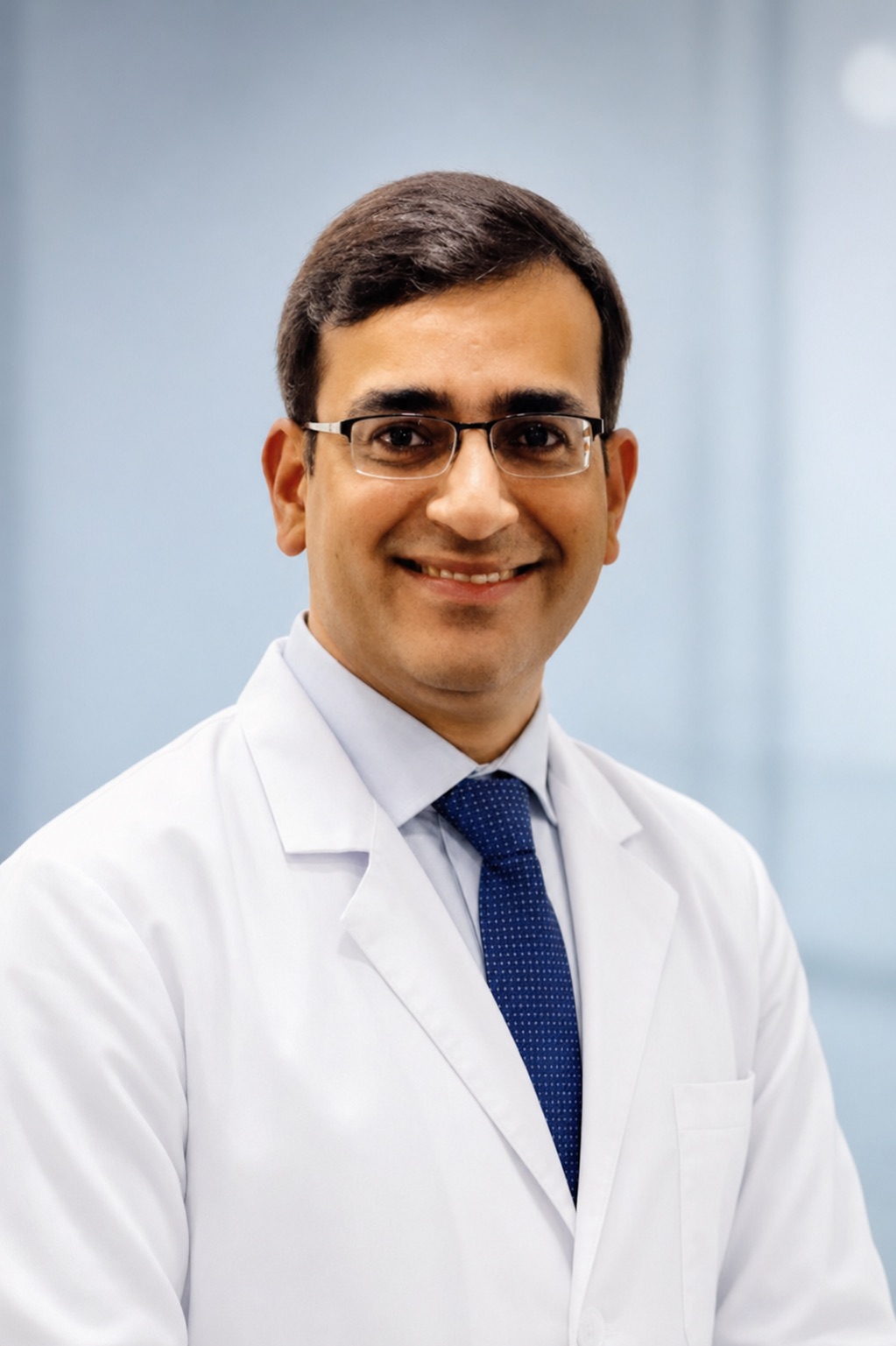
With training at the UK's National Health Service — where robotic-assisted phacoemulsification and premium IOL implantation are standard practice — Dr. Baweja introduced this level of cataract surgical excellence to the Chandigarh region. Every patient benefits from his meticulous pre-surgical biometry, personalised IOL selection, and refined surgical technique that minimises ultrasound energy and maximises visual outcomes.
Dr. Baweja's philosophy is straightforward: cataract surgery should not just restore your pre-cataract vision — it should be an opportunity to optimise your vision. Careful IOL selection and precision planning mean many patients see better after surgery than they have in decades.
Everything you want to know about cataract surgery at BMH — answered clearly and honestly.
Modern robotic AI cataract surgery at BMH is safer, faster, and more comfortable than ever before — and the results are transformative. Book your consultation today and let us restore the clarity you deserve.